a deeper look at how luke hughes’ skating aligns with where the nhl is heading
by Bridget Lombardo
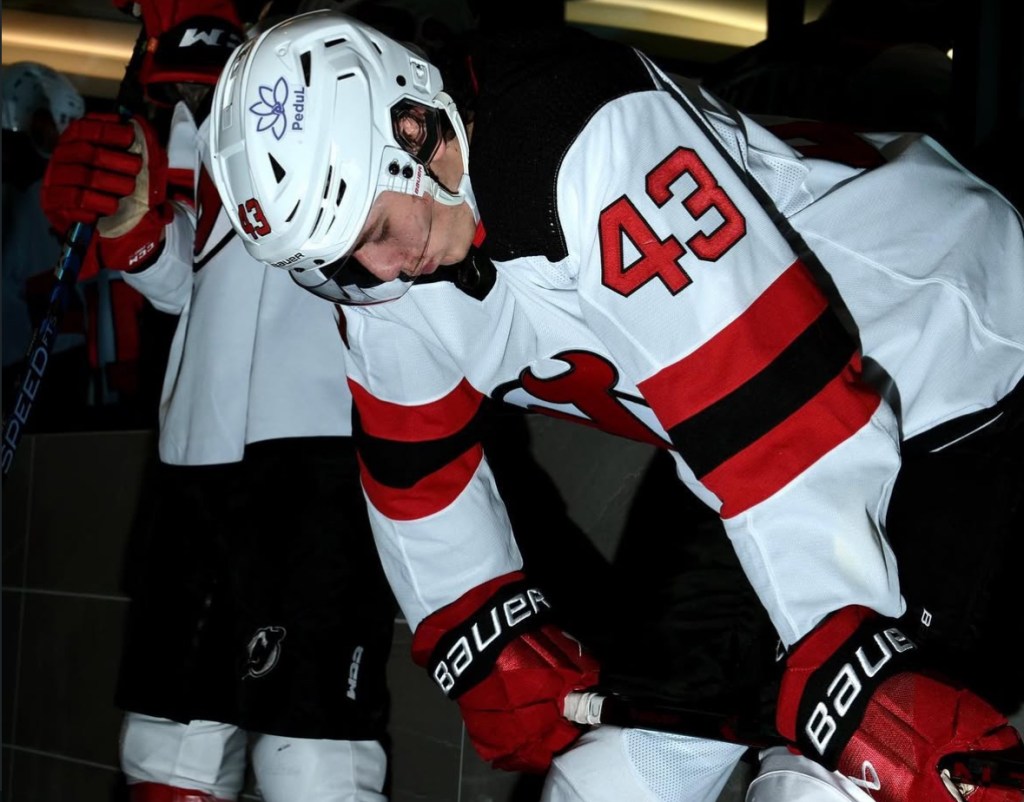
lhughes_06 / Instagram
Luke Hughes grew up in a household where hockey wasn’t just a sport—it was a way of life.
With Ellen-Weinberg Hughes, a former U.S. National Team player and three sport athlete at the University of New Hampshire, as his mom, and Jim Hughes, who spent years working in NHL player development after playing at Providence College, as his dad, Luke practically lived in a walking, talking hockey seminar before he ever put on real gear. Add in Jack and Quinn—two older brothers who were already skating circles around kids their age—and Luke didn’t really have a choice. The kid was destined to play hockey.
From Ellen, he picked up the basic mechanics a defenseman needs. From Jim, he got the way of thinking. From Jack and Quinn, however, he learned the rest of the game simply by trying to keep up. His skating didn’t show up when he hit Little Caesars, or the University of Michigan, or the New Jersey Devils. It came from growing up in a house where hockey was quite literally happening all the time.
That’s why, when you watch him now, he doesn’t skate like a 22-year-old still figuring it out. Despite the 2025-2026 season only being his third full season, he skates like a player who was built for the version of the NHL we’re currently watching unfold. There are these little moments (a pivot to escape pressure, a quick movement at the blue line that shifts the entire penalty kill, etc.) that make you realize he’s not just doing something right, but that he’s doing something ahead of schedule. The league has moved away from big, stay-at-home defensemen and toward guys who can move, think, and transition the puck with pace, and Luke fits that so naturally that it feels like he was raised for it. Because, honestly, he kind of was.
His stride is extremely smooth. He wastes no motion. His balance is the kind that makes escaping pressure look casual. Additionally, his edge work is where you really see Quinn’s influence—the ability to shift his weight an inch and make a defender lean in the wrong direction. His skating isn’t an accessory to his game, but the foundation of it. Everything the Devils do with him on the ice starts with his feet.
You notice it most in transition. The NHL is basically obsessed with transition right now. Every good team is built on speed, movement, and clean exits. Luke already plays like he’s been in that system for a decade. He’ll retrieve a puck, make one tight turn, and suddenly the Devils are heading up the ice with control. Luke turns pressure into opportunity, which is exactly what modern defense has become. While his numbers are never perfect in capturing skating itself, they confirm what meets the eye. In the 2024-2025 season, he finished with 44 points (7G, 37A) in 71 games, leading all Devils defensemen. He averaged 1.7 shots per game, which says a lot about how often he’s jumping into the play. On top of this, hitting 93 career points (17G, 76A) that early in his career isn’t normal for a young defenseman. Not unless you’re constantly involved in pushing play forward.
These stats don’t just say “he’s talented.” They say the way he skates makes the Devils better. He gives them more clean exits, more controlled entries, more east–west puck movement, and better scoring chances. His impact isn’t theoretical, but instead consistently shows up on the scoreboard and in how air shifts when he steps foot on the ice.
When you put everything together, it becomes pretty obvious that Luke doesn’t need to adjust to where the NHL is going. He’s already built for it. But let’s be for real—he’s been built for it since he was two years old on the outdoor rink, desperately trying to keep up with Quinn and Jack.
Or, in other words, Luke didn’t grow into this modern version of defense. He grew from it.
 Sports and Syntax
Leave a comment