has toronto’s pursuit of perfection become its greatest obstacle?
by Bridget Lombardo
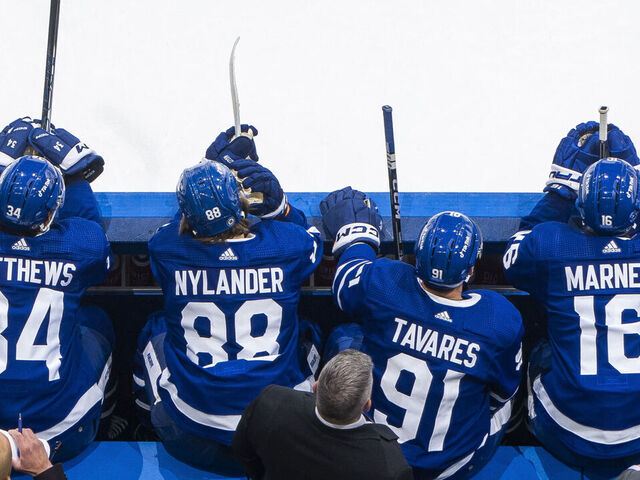
Mark Blinch / National Hockey League / Getty Images
Every season, the Toronto Maple Leafs enter the conversation the same way—loud, hopeful, and haunted. They have the talent, the market, the media power, and the money. They have players who can score from anywhere on the ice, and data analysts routinely rank them among the NHL’s best teams.
And yet, when it matters most, the Leafs find themselves in the same place, staring into the mirror of another postseason collapse.
Toronto’s story isn’t one of failure so much as it is of almosts. Almost ready. Almost there. Almost enough.
Since 2013, the Leafs have built one of the most talented cores in the NHL, acquiring players like Auston Matthews, Mitch Marner, William Nylander, John Tavares, and Morgan Reilly. On paper, it was a group capable of winning a Stanley Cup. But year after year, the team fell short.
Two playoff series win since 2004. Just a couple of fleeting moments of validation before the heartbreak returned.
For Leafs fans, it became less about hope and more about endurance—believing in what the team could be while fearing what history said it probably would be.
When Mitch Marner was traded to the Vegas Golden Knights in the summer of 2025, it felt like the symbolic end of an era.
Marner was more than just a player. He was part of Toronto’s identity. Drafted fourth overall in 2015, he represented homegrown brilliance—the local kid, creative playmaker, and the kind of talent that made fans believe the drought would finally end.
But after years of postseason frustration, something had to give. His departure wasn’t just a hockey move, but instead a cultural shift.
For the first time in seven years, the Maple Leafs’ “core four” wasn’t intact. The team’s longstanding question—can this group win together?—finally got its answer. No.
Now, Marner thrives in Vegas, free from the weight of Toronto’s microscope, while the Leafs are left to redefine themselves without one of their most polarizing (and beloved) stars.
Marner’s trade has forced the Leafs to confront something they’d avoided for too long: identity.
For years, they tried to build around skill, not chemistry. They were a team of elite players who never quite became an elite team. With Marner gone, leadership has shifted toward a more grounded approach.
Auston Matthews remains the centerpiece, now wearing the captain’s “C,” and William Nylander—once overshadowed by contract drama—has become a more vocal, mature presence. New additions, along with a coaching change under Craig Berube, have brought a tone of accountability that’s long been missing.
These aren’t the Leafs built for narratives. Instead, they’re the ones trying to write a new one. It’s a team trying to get back to a solid foundation—the kind that wins ugly, not beautifully.
The “Curse of Expectation” was never really about bad luck. It was about identity.
For too long, Toronto tried to live up to its own myth—a team destined to break a 50-year drought through high draft picks and extreme talent. Hockey, however, doesn’t reward narratives. It rewards adaptability.
Marner’s exit may finally give Toronto what it’s been missing.
The space to evolve.
Without the weight of expectation tied to a single core, the Leafs have a chance to become something new—not the team that should win, but the team that will.
Marner’s trade didn’t just end an era. Instead, it cracked open the door to the clarity Toronto has needed for years.
In other words, the real curse wasn’t failure. It was simply believing that anything less than perfection was.
And for the first time in a long time, the Leafs no longer need to outrun their past—they finally have room to outgrow it.
 Sports and Syntax
Leave a comment